






Digital Labs constitute the foundational research infrastructure of the SpaceArch New NASA program, operating as the distributed innovation engine for soft space exploration and future colonization systems. While traditional space agencies concentrate on heavy hardware missions, launch systems, and planetary engineering, the Digital Labs constellation focuses on the cognitive, computational, biological, architectural, and socio-technological frameworks required for sustainable human expansion beyond Earth. Through a globally interconnected network of AI-augmented research cells, Digital Labs accelerate the design of next-generation space habitats, autonomous infrastructure, advanced materials, bio-adaptive systems, and planetary settlement models. In this strategic context, Digital Labs function as the intellectual and technological backbone of SpaceArch New NASA, enabling rapid iteration, distributed discovery, and scalable innovation for the future colonization of the Solar System and beyond. 🚀
The SpaceArch New NASA model, supported by the universal infrastructure of Digital Labs, effectively democratizes access to space exploration and future colonization systems. Historically, the primary bottleneck in space development has not been the size of rockets or the power of propulsion systems, but rather the complexity of the software, scientific models, and integrated technologies required to design and operate advanced space systems. By creating a globally distributed network of AI-augmented Digital Labs, SpaceArch removes this barrier by opening access to technical knowledge, collaborative research, and advanced system design capabilities. As a result, countries with medium or emerging economies—such as Argentina—can realistically allocate significant investment, potentially in the range of one billion dollars or more, to well-defined space projects, just as they have historically financed major infrastructure initiatives such as hydroelectric dams or nuclear power plants. The true barrier was never capital alone, but access to coordinated scientific knowledge. With the Digital Labs infrastructure, that barrier effectively disappears.
The SpaceArch New NASA model, supported by the universal Digital Labs infrastructure, democratizes access to space exploration and future colonization systems. Historically, the main bottleneck in space development was not the rocket or propulsion technology, but the complex software, scientific models, and system architectures required to design advanced space infrastructure. By connecting global research talent through AI-augmented Digital Labs, SpaceArch removes this barrier and opens access to high-level technical knowledge. As a result, countries with medium or emerging economies—such as Argentina—can realistically allocate significant investments to defined space projects, just as they have done with major infrastructure such as hydroelectric dams or nuclear power plants. The true barrier was never capital alone, but access to coordinated scientific knowledge, and the Digital Labs constellation effectively eliminates that limitation. 🚀
A Distributed AI-Augmented Research Infrastructure for the Fourth Wave Economy
The Digital Labs (DL) System is a modular and scalable research infrastructure designed to operate through a distributed network of physical micro-labs interconnected through cloud computing and scientific artificial intelligence.
Developed within the SpaceArch ecosystem, Digital Labs integrate local coworking nodes, international research collaboration, artificial intelligence, freelancers, and open scientific participation into a single operational architecture.
The system enables high-efficiency innovation production, dramatically reducing the cost and time required to conduct scientific and technological research.
Unlike traditional laboratories, which are centralized, capital-intensive, and geographically limited, the Digital Labs model functions as a global constellation of interconnected research cells.
1. The Digital Lab Cell: Basic Operational Unit
The fundamental unit of the system is the Digital Lab Cell (DLC).
Each cell operates as a compact research team composed of:
- 6–8 scientific operators
- 1 programmer or systems engineer
- AI interface access
- cloud connectivity
Typical total team size:
8–10 active members per lab.
These teams perform:
- applied scientific research
- software development
- data analysis
- simulation
- technological prototyping
- innovation development for commercial clients
The Digital Lab Cell is designed to be fully replicable, allowing rapid global expansion.
2. Digital Labs Cloud Constellation
Individual labs are not isolated entities.
All Digital Lab Cells are interconnected through a cloud-based infrastructure, forming a global research network.
The architecture is organized as follows:
Digital Lab Cell
↓
National Digital Labs Network
↓
International Digital Labs Network
↓
Global Digital Labs Cloud
This creates a distributed scientific infrastructure capable of operating across multiple continents simultaneously.
The model resembles advanced distributed systems such as:
- CERN Grid Computing
- NASA distributed research networks
- Open Science Cloud platforms
However, the Digital Labs system extends these concepts into commercial innovation and technological development.
3. Scientific Artificial Intelligence Layer
At the center of the system operates a Scientific AI Interface.
This artificial intelligence layer acts as a cognitive coordination system for the entire network.
Core functions include:
• indexing research outputs across all Digital Labs
• identifying correlations between projects
• suggesting new hypotheses and research paths
• assisting scientists with data analysis
• coordinating distributed research teams
• accelerating discovery cycles
This AI layer effectively becomes a permanent research collaborator, enabling faster knowledge integration across the global network.
The architecture can be summarized as:
Digital Labs
↓
Cloud Data Layer
↓
Scientific AI Layer
↓
Global Knowledge Graph
This produces a continuously evolving collective scientific intelligence system.
4. Freelance Scientific Participation Layer
The Digital Labs architecture incorporates a global freelance research layer.
External contributors may participate in research projects through two operational modes.
Open Research Mode
In this model, projects are publicly accessible and open to participation from:
- freelance scientists
- independent researchers
- advanced students
- universities
- specialized professionals
Contributors receive royalties or recognition proportional to their verified contributions.
This model draws inspiration from successful distributed innovation systems such as:
- open-source software communities
- collaborative research platforms
- distributed problem-solving networks
Confidential Research Mode
For enterprise projects, Digital Labs operate under strict confidentiality frameworks.
These projects are conducted through:
- non-disclosure agreements (NDA)
- contractual research frameworks
- controlled access teams
Participants may include:
- core Digital Lab teams
- selected researchers
- specialized freelancers under contract
This mode enables the system to provide high-value R&D services to companies and institutions.
5. Online User Participation Layer
The outermost layer of the architecture allows online users and innovators to interact with the Digital Labs network.
Users may:
• propose research ideas
• request participation in projects
• contribute datasets
• collaborate in analysis tasks
• fund innovation challenges
• interact with the research community
This transforms the Digital Labs network into a hybrid research platform, combining elements of:
- collaborative innovation platforms
- distributed research communities
- scientific cloud infrastructure
6. Full System Architecture
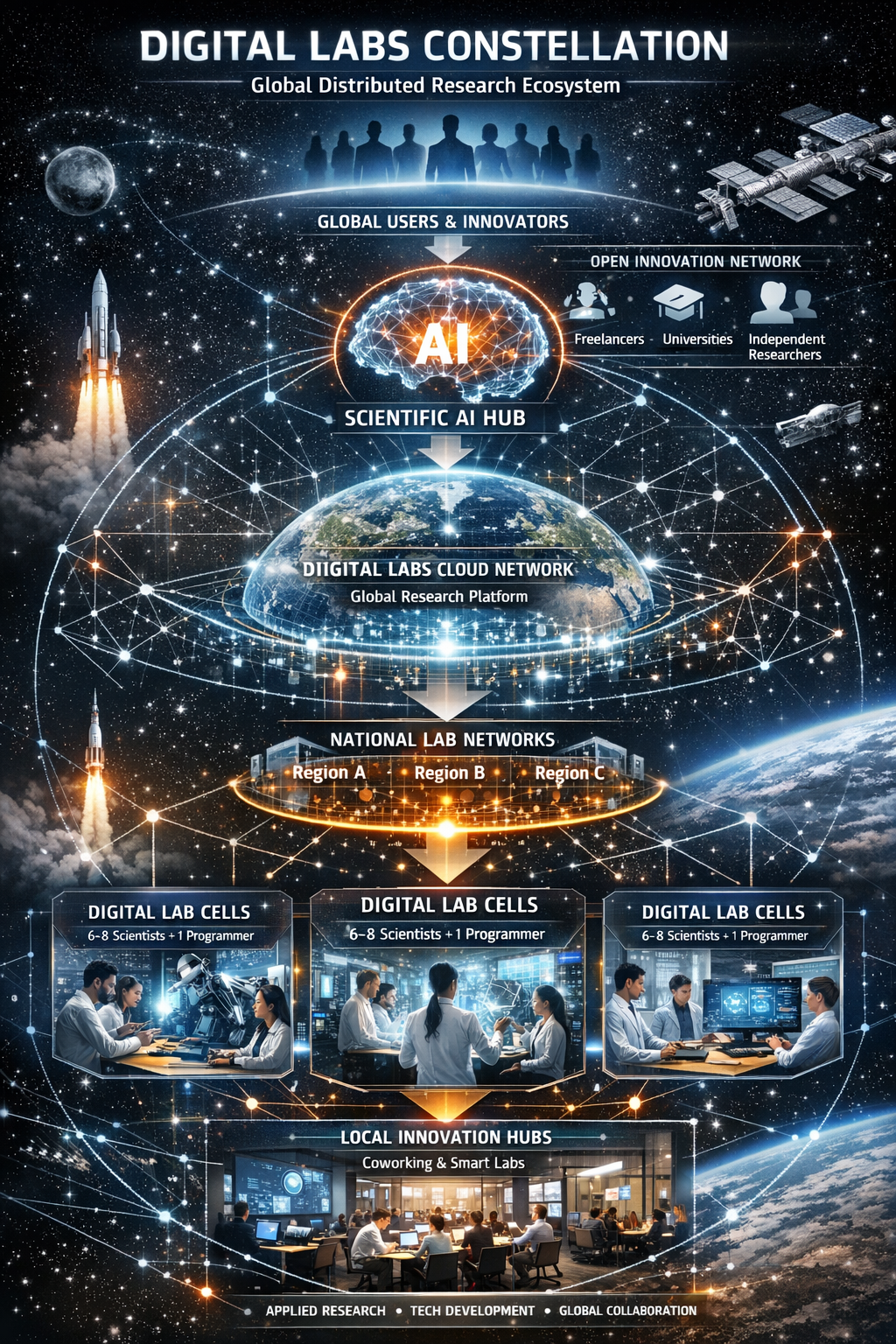
The Digital Labs ecosystem can be summarized in a multi-layer structure:
Online Users
↓
Freelance Scientific Network
↓
Scientific Artificial Intelligence
↓
Digital Labs Cloud Constellation
↓
Digital Lab Cells (6–8 scientists + programmer)
↓
Local Physical Nodes (Coworking / Innovation Hubs)
This creates a multi-layer research and innovation system capable of operating continuously across geographic and disciplinary boundaries.
7. Integration with Coworking Infrastructure
One of the most powerful aspects of the Digital Labs model is its compatibility with existing coworking environments.
A modern coworking space already contains most of the required infrastructure:
- laptops and workstations
- high-speed internet
- collaborative workspaces
- digital platforms and portals
- large smart screens for analysis and presentations
Because of this, a coworking node can instantly transform into a Digital Lab when a research contract or project is activated.
This makes the Digital Labs system commercially explosive, as it enables rapid conversion of flexible workspaces into fully operational innovation units.
In practical terms:
Coworking Space
→ Digital Lab Activation
→ Research Operations
This hybrid model dramatically reduces the capital expenditure traditionally required for research facilities.
8. Fractal Scalability
The Digital Labs system scales naturally through replication.
Example:
10 Digital Labs
→ approximately 80 researchers
100 Digital Labs
→ approximately 800 researchers
1000 Digital Labs
→ approximately 8000 researchers
All connected through the same AI-augmented knowledge infrastructure.
This creates the conditions for an emergent global scientific intelligence network.
9. A New Model of Scientific Production
The Digital Labs Constellation represents a new paradigm in innovation infrastructure.
It combines five traditionally separate systems:
- physical research laboratories
- distributed scientific collaboration
- artificial intelligence research assistants
- freelance global talent networks
- open innovation platforms
By integrating these elements into a unified architecture, Digital Labs enable a new model of scientific and technological production for the Fourth Wave economy.
10. Strategic Implications
The Digital Labs system allows organizations to:
• accelerate innovation cycles
• access global talent networks
• dramatically reduce research costs
• integrate AI directly into research workflows
• scale research capacity globally
This architecture represents the emergence of AI-augmented collective scientific intelligence.
Digital Labs Constellation Architecture
SpaceArch Distributed Research Infrastructure
                           GLOBAL USERS / INNOVATORS
                                    │
                                    │
                         Research proposals / datasets
                                    │
                                    ▼
                      ┌───────────────────────────┐
                      │   Open Innovation Layer   │
                      │ Freelancers / Universities│
                      │ Independent Researchers   │
                      └───────────────────────────┘
                                    │
                                    │ contributions / participation
                                    ▼
                      ┌───────────────────────────┐
                      │  Scientific AI Interface  │
                      │  Knowledge Graph Engine   │
                      │  Research Coordination AI │
                      └───────────────────────────┘
                                    │
                                    │ cognitive orchestration
                                    ▼
                     ┌─────────────────────────────┐
                     │ Digital Labs Cloud Network  │
                     │ Global Research Database    │
                     │ Project Coordination Layer  │
                     └─────────────────────────────┘
                                    │
                   ┌────────────────┼────────────────┐
                   │                │                │
                   ▼                ▼                ▼
         ┌───────────────┐ ┌───────────────┐ ┌───────────────┐
         │ National DL   │ │ National DL   │ │ National DL   │
         │ Network       │ │ Network       │ │ Network       │
         │ (Region A)    │ │ (Region B)    │ │ (Region C)    │
         └───────────────┘ └───────────────┘ └───────────────┘
                   │                │                │
                   ▼                ▼                ▼            ─────────── Digital Lab Cells ───────────        ┌──────────────────────────────────────────────┐
        │              Digital Lab Cell                │
        │                                              │
        │ 6–8 Scientific Operators                     │
        │ 1 Programmer / Systems Engineer              │
        │ AI Research Interface                        │
        │ Cloud Research Access                        │
        │                                              │
        │ Applied Research / Development / Simulation  │
        └──────────────────────────────────────────────┘                           │
                           │ physical infrastructure
                           ▼                ┌──────────────────────────────┐
                │  Local Innovation Nodes      │
                │  Coworking / DL Spaces       │
                │  Laptops / WiFi / Smart Labs │
                └──────────────────────────────┘
Conceptual System Layers
1. Physical Layer
Local Innovation Nodes
Coworking spaces and Digital Lab locations.
Infrastructure includes:
- laptops
- high-speed internet
- collaborative workspace
- smart screens
- cloud connectivity
- project management portals
These nodes can immediately transform into Digital Labs when research projects are activated.
This is why your coworking model is so powerful.
Coworking
→ Digital Lab activation
→ Research production.
2. Digital Lab Cell Layer
Each DL Cell contains:
6–8 scientific operators
1 programmer / engineer
AI interface access
Functions:
- scientific research
- software development
- simulations
- engineering prototypes
- innovation consulting
This is the replicable unit of the system.
3. National DL Network
Multiple labs in a country connect into a national research network.
This allows:
- project coordination
- shared resources
- regional innovation programs
4. Global DL Cloud
All national networks integrate into the Digital Labs Cloud Constellation.
Functions:
- shared research databases
- project coordination
- cross-disciplinary collaboration
- knowledge repository
This layer creates a global distributed laboratory.
5. Scientific AI Layer
The Scientific AI Interface coordinates the entire ecosystem.
Functions:
• research indexing
• knowledge graph creation
• discovery acceleration
• hypothesis generation
• team coordination
This transforms the network into an AI-augmented research intelligence system.
6. Freelancer Scientific Network
External contributors join through the cloud.
Participants:
- freelance scientists
- universities
- students
- independent experts
Two modes:
Open Research Mode
royalty participation
Confidential Research Mode
NDA and enterprise projects.
7. Global Innovation Layer
The outer layer allows global participation.
Users may:
- propose research ideas
- provide datasets
- participate in innovation challenges
- collaborate in scientific development
This transforms the system into a hybrid research platform.
The Full System Logic
The architecture operates as a multi-layer distributed intelligence network.
Flow of knowledge:
Users / innovators
↓
Freelance researchers
↓
Scientific AI coordination
↓
Digital Labs Cloud
↓
DL Cells
↓
Local Innovation Nodes
Strategic Interpretation
The Digital Labs architecture creates something very powerful:
a global AI-augmented scientific production system.
Instead of relying on a few expensive laboratories, innovation becomes:
distributed
scalable
collaborative
AI-accelerated.
Why coworking node fits perfectly
SpaceArch coworking node already contains the required infrastructure:
- laptops
- internet
- digital platforms
- smart screens
- collaborative workspace
Therefore it can instantly mutate into a Digital Lab when a project contract appears.
This dramatically reduces the capital cost of research infrastructure.
Final Concept
Digital Labs =
Distributed Scientific Infrastructure for the Fourth Wave Economy
or in a simpler formula:
DL = Coworking + Cloud + AI + Global Talent