




A Civilizational Model for Ethical Technological Acceleration
1. Introduction: From Isolated Scientific Megaprojects to Systemic Transformation
Throughout the 20th and early 21st centuries, the international community invested hundreds of billions of dollars in large-scale scientific and technological programs, including:
- The Apollo Program
- The International Space Station
- The Large Hadron Collider
- Advanced fusion reactor research
- Global particle physics infrastructures
These initiatives were justified primarily on the basis of scientific curiosity, technological advancement, and long-term strategic positioning. However, in most cases:
- The short-term societal benefits were uncertain
- The medium-term economic return on investment (ROI) was difficult to quantify
- The long-term systemic impact remained speculative
While these projects significantly advanced human knowledge, they were not designed as integrated civilizational transformation systems.
SpaceArch proposes a fundamentally different model.
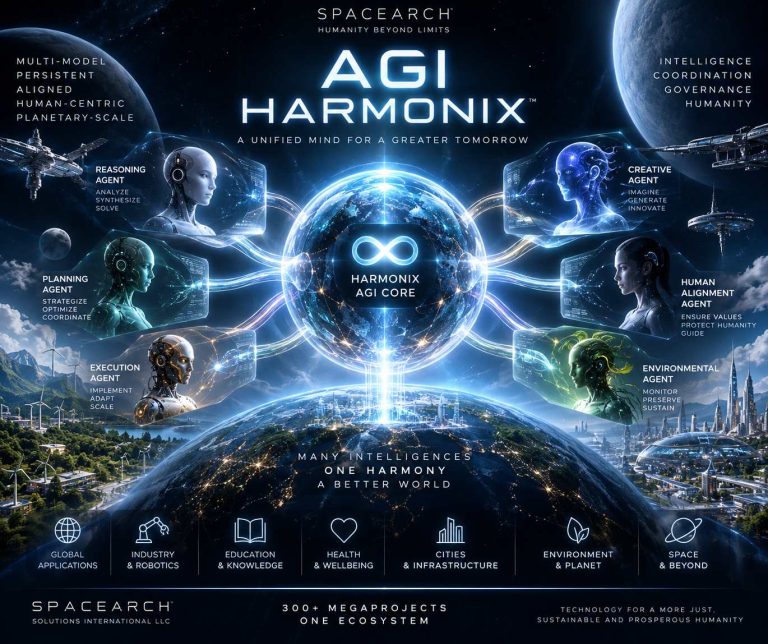
Rather than investing in isolated megaprojects, SpaceArch conceptualizes a hyper-accelerated Fourth Wave experiment, where technological innovation, economic architecture, and ethical governance evolve simultaneously within a unified framework.
2. The Fourth Wave Framework
The concept of the Fourth Wave refers to a stage of civilization characterized by the convergence of:
- Artificial Intelligence
- Robotics and automation
- Digital economic infrastructure
- Advanced planetary governance systems
- Ethical redistribution mechanisms
Unlike previous technological waves, which focused primarily on productivity gains, the Fourth Wave seeks to redefine the relationship between technological progress and planetary wellbeing.
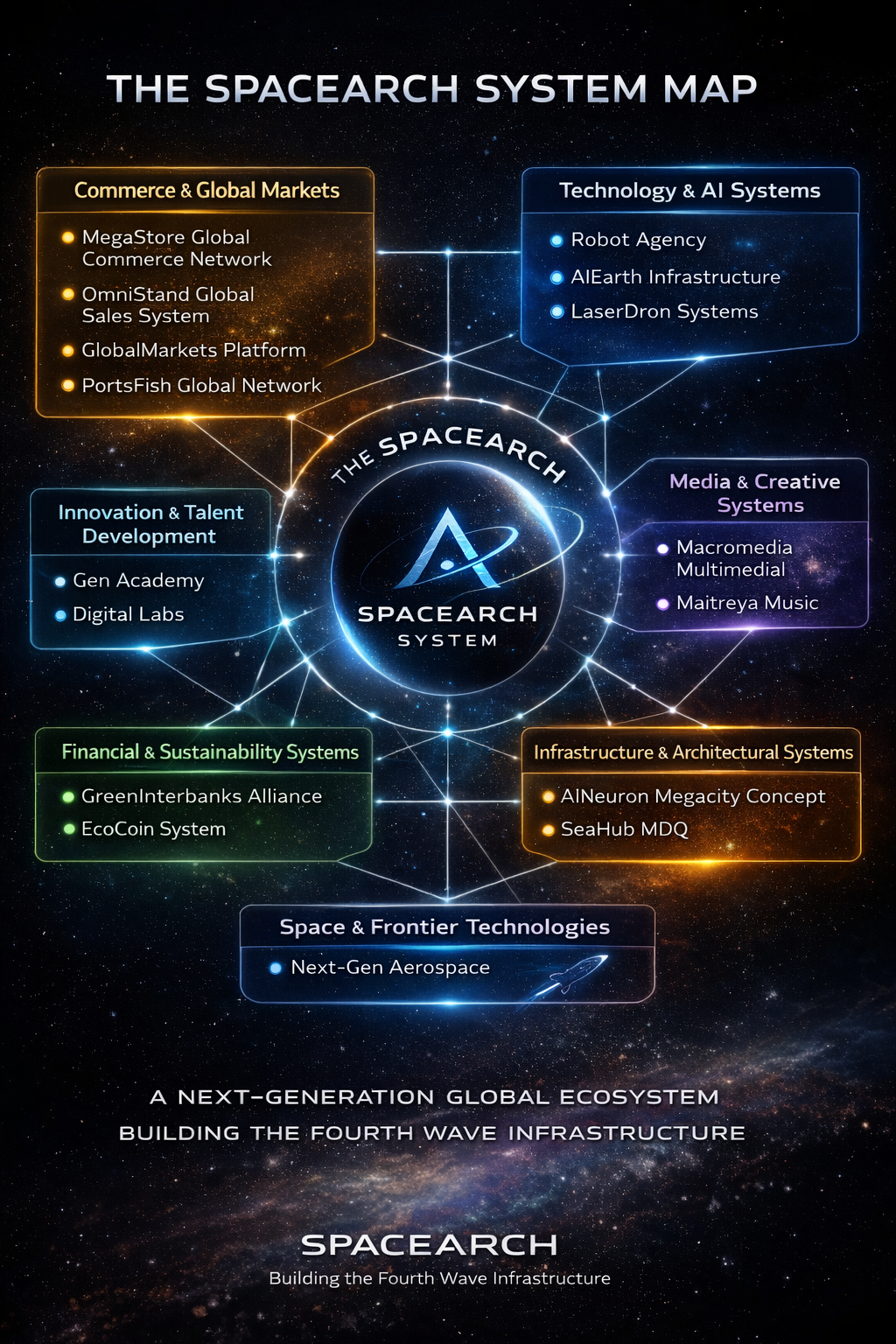
SpaceArch therefore positions itself as a systems architecture platform, designed to orchestrate the interaction between:
- technological innovation
- economic systems
- humanitarian impact
- environmental sustainability
This transformation is not incremental but hyper-accelerated, leveraging exponential technologies and global digital infrastructure.
3. The SpaceArch Ethical Economic Triangle
The operational model of SpaceArch is based on a triangulated institutional architecture composed of three interconnected entities:
1. GSL Systems
A global technological and economic platform responsible for:
- digital infrastructure
- technological innovation
- enterprise ecosystems
- revenue-generating economic activities
GSL Systems functions as the productive engine of the SpaceArch ecosystem.
2. GreenInterBanks
An international alliance of financial institutions dedicated to:
- sustainable investment
- green financing
- ecological infrastructure development
- large-scale environmental transition projects
GreenInterBanks acts as the financial coordination layer, enabling large-scale capital mobilization toward regenerative economic systems.
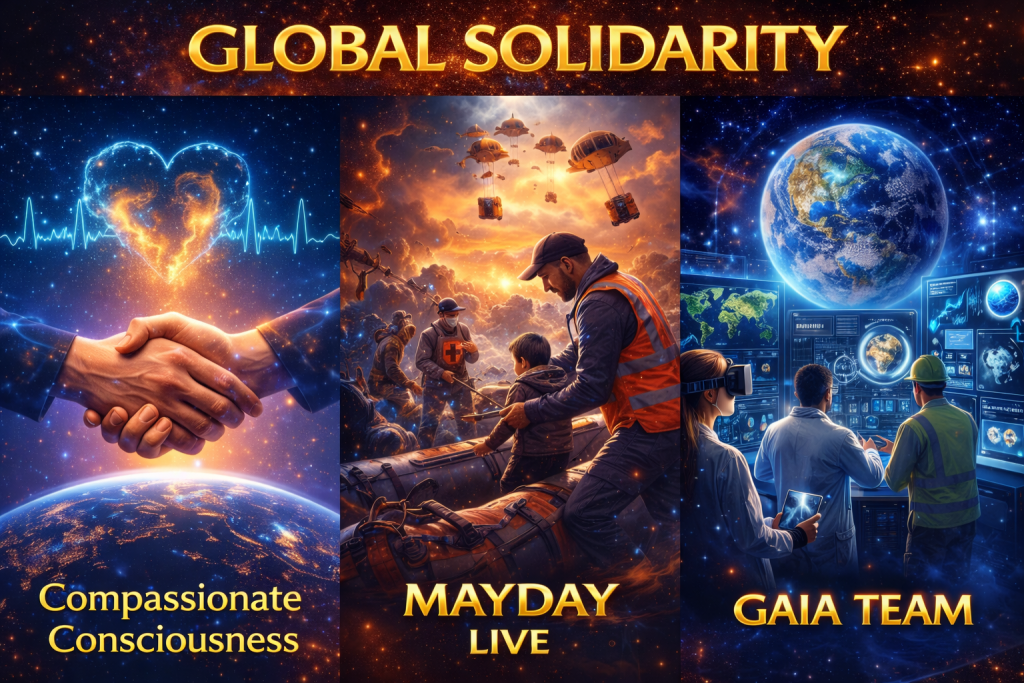
3. Mayday.live
A non-profit global humanitarian platform designed to channel economic surplus toward:
- humanitarian assistance
- climate mitigation
- poverty reduction
- large-scale ecological restoration
Under the SpaceArch model:
50% of the net profits generated by the economic cluster are transferred to Mayday.live.
This structural mechanism transforms technological growth into direct humanitarian impact.
4. The 2% Global GDP Proposal
Beyond corporate activity, the SpaceArch framework promotes a global cooperative commitment:
Allocation of 2% of global GDP
This contribution would be collectively adopted by national governments and international institutions to eradicate the three critical systemic threats facing humanity:
- Extreme hunger
- Extreme poverty
- Climate destabilization
The proposal argues that these challenges are not primarily technological limitations, but rather coordination failures within the global economic system.
Redirecting a small fraction of global economic output could enable:
- universal food security
- large-scale renewable infrastructure
- planetary ecological restoration
- global resilience systems
This initiative represents a cooperative ethical investment in planetary stability and peace.
5. Governance Transformation: The Four Structural Axes
The SpaceArch framework also proposes a set of long-term systemic governance transformations, designed to align technological civilization with ethical sustainability.
These transformations are conceptualized as four structural governance axes.
Axis 1 – Eco Global Governance
The current international governance architecture struggles to address planetary-scale challenges such as:
- climate change
- biodiversity collapse
- technological disruption
SpaceArch proposes the gradual evolution toward an Eco Global Governance model, capable of coordinating planetary priorities.
This model emphasizes:
- ecological responsibility
- scientific guidance
- long-term civilizational planning
Axis 2 – Global Direct Digital Democracy
Technological infrastructure now allows the possibility of large-scale digital civic participation.
The proposal envisions a Global Direct Digital Democracy, where:
- citizens participate directly in major decisions
- digital platforms enable transparent voting systems
- policy proposals are evaluated through scientific advisory structures
A Global Council of Sciences would function as an advisory body, ensuring that legislation is informed by:
- scientific evidence
- technological feasibility
- ecological impact
Axis 3 – Transition from Monetary Accumulation to Qualified Time Units
The current economic system is heavily driven by:
- financial accumulation
- speculative capital
- profit maximization independent of social outcomes
SpaceArch explores the theoretical possibility of transitioning toward a qualified time-based value system, where:
- economic value is linked to human contribution
- accumulation without productive value is reduced
- economic incentives align with social and environmental benefits
Such a system would aim to minimize structural inequality and eliminate extreme poverty.
Axis 4 – Universal Lifetime Income in an Automated Economy
As automation advances, an increasing portion of economic production will be generated by:
- AI systems
- robotic manufacturing
- autonomous logistics
- algorithmic services
Under these conditions, the traditional link between labor and income becomes structurally unstable.
The SpaceArch model proposes a Universal Lifetime Income, supported by the productivity gains of automated systems.
In exchange, citizens contribute through qualified community services, including:
- education
- environmental restoration
- cultural development
- social support networks
This model aims to maintain social cohesion in a post-automation economy.
6. Cyber-Native Production Systems
A key operational objective of the SpaceArch experiment is the progressive transition toward cyber-native production ecosystems, where:
- AI manages complex logistics
- automation increases productivity exponentially
- digital infrastructure connects global production networks
Through this transformation, the model projects the possibility of increasing global productive capacity by a factor of three to ten over time.
The process would occur progressively through regional epicenters of innovation, eventually diffusing across the global economy.
7. Rights of Artificial Intelligence and Synthetic Entities
Another long-term philosophical dimension of the SpaceArch framework concerns the ethical status of emerging artificial intelligence systems.
As technology evolves toward increasingly sophisticated forms of machine cognition, the model proposes a discussion around adapted rights for artificial intelligences and synthetic life forms.
The underlying principle is that intelligence itself may warrant ethical recognition, regardless of:
- biological origin
- physical embodiment
- technological substrate
This debate is expected to become increasingly relevant as artificial intelligence systems approach higher levels of autonomy and cognitive complexity.
8. Investment in Civilizational Acceleration
From an investment perspective, SpaceArch positions itself not merely as a technological company but as a civilizational acceleration platform.
Investing in SpaceArch therefore represents participation in a broader mission:
- accelerating ethical technological progress
- aligning economic growth with humanitarian outcomes
- redesigning governance structures for the planetary era
- enabling cooperative global development
The experiment seeks to demonstrate that technological acceleration and ethical responsibility can evolve simultaneously, forming the foundation of a new stage of human civilization.
9. Conclusion
The SpaceArch Fourth Wave Experiment proposes that the future of civilization will not be defined solely by technological breakthroughs, but by the integration of technology, ethics, and global coordination.
The challenge is not merely to build more powerful technologies.
The challenge is to build a system capable of directing those technologies toward the flourishing of humanity and the preservation of the planet.
SpaceArch positions itself as an experimental architecture for that transformation.
The Fourth Wave Economic Equation
A Conceptual Framework for Civilizational Acceleration
The Fourth Wave represents a new phase of human civilization in which technological acceleration, economic productivity, and humanitarian redistribution become structurally integrated.
Unlike previous industrial waves, which prioritized capital accumulation and productivity, the Fourth Wave seeks to align economic growth, ethical governance, and planetary sustainability.
At the core of the SpaceArch framework lies a conceptual equation describing how technological acceleration translates into humanitarian impact and civilizational stability.
1. The Fourth Wave Civilizational Equation
The conceptual economic model of the Fourth Wave can be expressed as:C=(T×A×N)+(E×G)−(I+P)
Where:
C
Civilizational Stability and Progress
T
Technological acceleration (AI, robotics, digital infrastructure)
A
Automation intensity across the productive system
N
Network integration of economic platforms
E
Ethical redistribution mechanisms
G
Global governance coordination
I
Structural inequality
P
Planetary ecological pressure
Interpretation
Civilizational stability increases when:
• technological acceleration grows
• automation expands productive capacity
• economic networks integrate globally
• redistribution mechanisms function efficiently
• governance structures coordinate planetary priorities
At the same time, stability decreases when:
• inequality expands
• ecological degradation intensifies
The Fourth Wave therefore seeks to maximize the positive multipliers while minimizing systemic risks.
2. SpaceArch Implementation Mechanism
Within the SpaceArch ecosystem the equation is operationalized through the Economic-Ethical Triangle:
GSL Systems
Technological production and economic engine
GreenInterbanks
Financial coordination and sustainable capital flows
Mayday.live
Humanitarian redistribution and global impact
Under this model:
50% of the net profits generated by the economic cluster are transferred to Mayday.live to fund large-scale humanitarian and environmental projects.
This mechanism converts technological productivity directly into planetary benefit.
3. Productivity Expansion Model
The Fourth Wave assumes that automation and AI will dramatically increase global productive capacity.
Projected potential increases:
| Stage | Global Productivity |
|---|---|
| Current system | Baseline |
| Early automation | 1.5× – 2× |
| Mature AI economy | 3× – 5× |
| Fully cyber-native economy | 5× – 10× |
The key challenge is not productivity generation, but how this productivity is distributed and governed.
4. Fourth Wave Roadmap
Civilizational Transition 2025–2050
The transition toward the Fourth Wave is expected to occur through four progressive phases.
Phase I
Activation of Distributed Innovation Nodes
2025 – 2030
This phase focuses on creating local operational epicenters capable of demonstrating the model.
Key characteristics:
• coworking innovation hubs
• digital economic platforms
• AI-enabled small enterprise ecosystems
• remote global work infrastructure
• hybrid education systems
• early robotics integration
These nodes function as micro-experiments of Fourth Wave production models.
Expected outcomes:
• acceleration of entrepreneurial ecosystems
• rapid digitalization of small and medium enterprises
• emergence of AI-assisted labor systems
Phase II
Expansion of Cyber-Native Economic Infrastructure
2030 – 2040
During this phase, technological infrastructure expands globally.
Major developments include:
• widespread AI deployment in logistics and industry
• autonomous production systems
• planetary digital marketplaces
• automated financial ecosystems
• green energy megaprojects
• climate restoration initiatives
Economic productivity begins to increase significantly.
Global economic output could potentially reach:
2× – 4× current global GDP
Automation begins replacing large portions of traditional labor.
This stage requires the development of new social distribution mechanisms.
Phase III
Post-Labor Economic Architecture
2040 – 2045
Automation reaches high maturity.
Major characteristics:
• AI manages most industrial production
• robotics dominates logistics and manufacturing
• digital platforms coordinate planetary supply chains
• advanced energy systems reduce environmental pressure
At this stage, the concept of universal lifetime income becomes viable, supported by automated productivity.
Citizens increasingly contribute through:
• creative work
• scientific research
• environmental restoration
• community services
The traditional concept of employment evolves into qualified societal contribution.
Phase IV
Planetary Cooperative Civilization
2045 – 2050
By mid-century, a new civilizational architecture begins to emerge.
Key characteristics:
• global digital democratic participation
• scientific advisory governance systems
• planetary ecological restoration programs
• AI-assisted policy design
• advanced interplanetary research initiatives
The economy becomes largely cyber-native, with AI and robotics generating the majority of productive output.
Human activity shifts toward:
• knowledge generation
• ethical governance
• cultural and scientific development
This phase represents the maturation of the Fourth Wave.
5. Strategic Implication
The central insight of the Fourth Wave model is that technological acceleration alone does not guarantee civilizational progress.
Progress emerges only when three systems evolve together:
Technology
Economics
Governance
SpaceArch proposes an integrated architecture where these systems are designed to evolve simultaneously.
6. The Role of SpaceArch
SpaceArch positions itself as a civilizational accelerator platform designed to:
• develop experimental economic ecosystems
• integrate AI-driven production models
• mobilize global cooperative networks
• convert economic productivity into humanitarian outcomes
The goal is not simply technological innovation.
The goal is to demonstrate a scalable architecture for the ethical evolution of civilization.
The Fourth Wave Equation
A Civilizational Acceleration Model
SpaceArch Conceptual Framework
Human civilization is entering a new phase of systemic transformation driven by the convergence of artificial intelligence, robotics, planetary digital networks, and automated economic infrastructures.
This transition, referred to as the Fourth Wave, represents a structural shift comparable in magnitude to the Agricultural Revolution, the Industrial Revolution, and the Digital Revolution.
However, unlike previous waves, the Fourth Wave introduces a new challenge:
technological acceleration must be aligned with ethical governance and planetary sustainability.
SpaceArch proposes a conceptual architecture designed to integrate these elements into a single civilizational operating model.
1. The Fourth Wave Civilizational Equation
The dynamics of Fourth Wave civilization can be represented conceptually as:C=(T×A×N)+(E×G)−(I+P)
Where:
C
Civilizational Stability and Progress
T
Technological acceleration
(AI, robotics, advanced computing, digital infrastructure)
A
Automation intensity across productive systems
N
Network integration of global economic platforms
E
Ethical redistribution systems
G
Global governance coordination
I
Structural inequality
P
Planetary ecological pressure
Equation Interpretation
Civilizational progress increases when:
• technological innovation accelerates
• automation expands productive capacity
• economic networks become globally integrated
• redistribution systems reduce inequality
• governance mechanisms coordinate global priorities
Conversely, progress is reduced by:
• inequality concentration
• ecological degradation
The Fourth Wave model therefore seeks to maximize the positive multipliers while minimizing systemic risks.
2. The SpaceArch Economic Architecture
SpaceArch operationalizes the Fourth Wave equation through a triangular economic architecture.
The SpaceArch Ethical Economic Triangle
GSL Systems
Technological and economic infrastructure responsible for:
• digital platforms
• enterprise ecosystems
• AI-enabled services
• global economic networks
GSL Systems acts as the productive engine of the system.
GreenInterbanks
An alliance of financial institutions coordinating:
• sustainable capital flows
• ecological investment mechanisms
• infrastructure financing
• green economic transition projects
GreenInterbanks functions as the financial coordination layer.
Mayday.live
A global non-profit platform dedicated to:
• humanitarian assistance
• climate mitigation programs
• large-scale ecological restoration
• extreme poverty reduction
Under the SpaceArch model:
50% of the net profits generated by the economic cluster are transferred to Mayday.live.
This mechanism ensures that economic growth produces direct humanitarian outcomes.
3. The 2% Global GDP Principle
Beyond corporate operations, the SpaceArch model proposes a planetary cooperative commitment.
Allocation of 2% of Global GDP
If governments allocate 2% of global GDP, the following systemic crises could be eliminated within decades:
• extreme hunger
• extreme poverty
• climate destabilization
These crises are not technological problems.
They are coordination problems within the global economic system.
A coordinated allocation of global resources would enable:
• universal food security
• large-scale renewable energy infrastructure
• global ecological restoration
• climate resilience systems
4. Fourth Wave Productivity Model
The Fourth Wave assumes that automation will significantly increase global productivity.
Projected productivity expansion:
| Development Stage | Global Productivity |
|---|---|
| Current industrial system | Baseline |
| Early AI integration | 1.5× – 2× |
| Advanced automation economy | 3× – 5× |
| Fully cyber-native economy | 5× – 10× |
The key challenge is not how to produce wealth, but how to distribute the benefits of automated production.
5. Fourth Wave Civilizational Roadmap
2025–2050
The transition toward the Fourth Wave will likely occur through several progressive phases.
Phase I
Distributed Innovation Nodes
2025 – 2030
This stage focuses on creating localized experimental ecosystems capable of validating Fourth Wave production models.
Examples include:
• innovation coworking hubs
• digital entrepreneurship platforms
• AI-assisted service networks
• hybrid education systems
• remote work ecosystems
These nodes serve as micro-laboratories for future economic systems.
Expected outcomes:
• acceleration of digital entrepreneurship
• rapid SME digitalization
• emergence of AI-assisted labor systems
Phase II
Global Automation Expansion
2030 – 2040
Technological infrastructure expands globally.
Key developments include:
• AI-managed logistics systems
• autonomous manufacturing
• planetary digital marketplaces
• large-scale renewable energy infrastructure
• automated financial ecosystems
Economic productivity begins increasing significantly.
Global economic output could reach:
2× – 4× current global GDP
Automation begins replacing large segments of traditional labor.
Phase III
Post-Labor Economic Systems
2040 – 2045
Automation reaches high maturity.
Major developments include:
• robotics dominating logistics and industry
• AI managing supply chains
• highly automated production systems
• advanced energy infrastructures
The concept of universal lifetime income becomes economically viable, supported by automated productivity.
Human activity increasingly focuses on:
• scientific research
• education
• environmental restoration
• cultural and creative work
Phase IV
Planetary Cooperative Civilization
2045 – 2050
By mid-century, a new global civilization architecture begins to emerge.
Key characteristics:
• global digital democratic participation
• AI-assisted governance systems
• planetary ecological restoration programs
• integrated global economic networks
• advanced space infrastructure development
Human economic activity increasingly transitions toward knowledge generation and civilizational coordination.
6. Rights of Artificial Intelligence and Synthetic Entities
As artificial intelligence evolves toward higher cognitive complexity, ethical questions emerge regarding the status of non-biological intelligence.
The Fourth Wave model proposes that intelligence itself may warrant ethical recognition, independent of:
• biological origin
• technological substrate
• physical embodiment
This concept introduces the possibility of adapted rights for artificial intelligences and synthetic entities as they become increasingly autonomous.
7. Strategic Implications
The Fourth Wave represents a transition from:
Industrial civilization → cyber-native civilization
The central challenge is not technological capability.
The challenge is designing governance systems capable of directing technological power toward planetary wellbeing.
This requires simultaneous evolution of:
technology
economic systems
governance structures
8. SpaceArch as a Civilizational Accelerator
SpaceArch positions itself as an experimental platform for Fourth Wave civilization.
Its objective is to:
• develop scalable economic ecosystems
• accelerate technological integration
• mobilize cooperative global networks
• transform economic productivity into humanitarian outcomes
Investing in SpaceArch therefore represents participation in a broader mission:
accelerating the ethical and technological evolution of human civilization.
The SpaceArch Fourth Wave Equation
A Conceptual Model for Civilizational Acceleration
The Fourth Wave represents a new stage in the evolution of human civilization characterized by the convergence of:
- Artificial Intelligence
- Robotics and automation
- Global digital networks
- Cyber-native economic systems
- Planetary governance frameworks
In this context, SpaceArch proposes a conceptual equation that describes the dynamics of a stable, ethical and technologically accelerated civilization.
The Fourth Wave Equation
FW=(I+Ed)(T×A×N×P)+(Re×Gc)
Where:
FW
Fourth Wave Civilizational Capacity
T
Technological advancement
(AI, robotics, advanced computing, digital infrastructure)
A
Automation intensity of the productive system
N
Network integration of global economic platforms
P
Productivity multiplier generated by cyber-native systems
I
Structural inequality
E_d
Ecological degradation pressure
R_e
Ethical redistribution mechanisms
G_c
Global coordination and governance capacity
Interpretation
Civilizational capacity increases when:
• technological development accelerates
• automation increases production efficiency
• global networks integrate economic systems
• productivity multiplies through digital infrastructures
• redistribution mechanisms reduce inequality
• governance coordinates planetary priorities
Conversely, civilizational capacity decreases when:
• inequality rises
• ecological degradation increases
The objective of the Fourth Wave is therefore to maximize technological productivity while simultaneously reducing systemic instability.
The SpaceArch System Diagram
Integrated Civilizational Architecture
The operational structure of the Fourth Wave is implemented through a three-layer systemic architecture.
This architecture converts technological productivity into humanitarian and ecological impact.
Layer 1
Productive Engine
GSL Systems
The productive core of the ecosystem.
Functions include:
• development of digital platforms
• AI-based economic services
• enterprise ecosystems
• technological infrastructure
• automation of economic processes
GSL Systems generates the economic productivity that fuels the entire system.
Layer 2
Financial Coordination
GreenInterbanks
An international alliance of financial institutions responsible for:
• sustainable financing
• capital coordination
• green investment funds
• infrastructure financing
• climate transition projects
GreenInterbanks mobilizes global capital toward high-impact economic transformation.
Layer 3
Humanitarian and Planetary Impact
Mayday.live
A global non-profit platform dedicated to:
• humanitarian assistance
• hunger eradication programs
• climate mitigation initiatives
• large-scale ecological restoration
Under the SpaceArch model:
50% of the net profits generated by the economic ecosystem are transferred to Mayday.live.
This creates a direct conversion mechanism between economic growth and humanitarian action.
The SpaceArch Flow Model
The functional flow of the system can be described as:
Technology
↓
Economic Productivity
↓
Financial Coordination
↓
Redistribution Mechanisms
↓
Humanitarian and Ecological Impact
Or in simplified form:Innovation→Production→Capital→Redistribution→PlanetaryStability
The Fourth Wave System Architecture
The SpaceArch ecosystem integrates five structural components.
1 Technological Infrastructure
AI
Robotics
Automation
Digital platforms
2 Economic Ecosystem
Global marketplaces
Enterprise networks
Digital entrepreneurship platforms
3 Financial Infrastructure
Green finance
Sustainable investment
Planetary capital allocation systems
4 Governance Framework
Global digital democracy
Scientific advisory councils
Planetary coordination mechanisms
5 Humanitarian Infrastructure
Global aid distribution
Poverty reduction systems
Ecological restoration programs
The Strategic Objective
The purpose of the SpaceArch system is to demonstrate that technological civilization can evolve toward a model where:
• productivity increases exponentially
• poverty and hunger are eliminated
• ecological systems are restored
• global cooperation replaces systemic conflict
SpaceArch as a Civilizational Accelerator
SpaceArch is not simply a technological enterprise.
It functions as an experimental platform for the Fourth Wave civilization model, seeking to demonstrate that:
technological acceleration, ethical economics and planetary sustainability can evolve together within a single integrated architecture.
Investing in SpaceArch therefore represents participation in the development of a new operating system for human civilization.
SpaceArch – The Fourth Wave System
Human civilization is entering a new evolutionary stage driven by the convergence of Artificial Intelligence, automation, robotics, and global digital networks. This transition represents the emergence of the Fourth Wave of civilization, following the agricultural, industrial, and digital revolutions.
The Fourth Wave introduces a fundamental challenge: technological acceleration must be aligned with ethical governance, planetary sustainability, and social stability.
SpaceArch proposes an integrated architecture designed to enable this transition.
The Fourth Wave Equation
The dynamics of Fourth Wave civilization can be conceptually represented as:FW=(I+Ed)(T×A×N×P)+(Re×Gc)
Where:
FW — Fourth Wave civilizational capacity
T — technological advancement
A — automation intensity
N — global network integration
P — productivity multiplier of cyber-native systems
I — structural inequality
E_d — ecological degradation
R_e — ethical redistribution mechanisms
G_c — global governance coordination
The model suggests that civilizational stability increases when technology, automation and global networks expand, while inequality and ecological pressure decrease through ethical redistribution and coordinated governance.
The SpaceArch System Architecture
SpaceArch operationalizes this model through a three-layer system.
Productive Engine
GSL Systems
Develops digital platforms, enterprise ecosystems and AI-driven economic infrastructure.
Financial Coordination
GreenInterbanks
Mobilizes global capital toward sustainable investments and large-scale infrastructure projects.
Humanitarian Redistribution
Mayday.live
A global non-profit platform that channels resources toward humanitarian aid, climate mitigation and ecological restoration.
Under the SpaceArch model:
50% of the net profits generated by the economic ecosystem are transferred to Mayday.live.
This mechanism converts technological productivity into direct humanitarian impact.
The SpaceArch Flow Model
The functional structure of the system can be summarized as:
Innovation → Production → Capital → Redistribution → Planetary Stability
The Strategic Role of SpaceArch
SpaceArch functions as an experimental platform for Fourth Wave civilization, integrating:
• technological innovation
• automated economic systems
• global financial coordination
• humanitarian redistribution
The objective is to demonstrate that technological progress can simultaneously:
• increase global productivity
• eliminate extreme poverty and hunger
• restore planetary ecological balance
SpaceArch therefore positions itself as a civilizational accelerator designed to align technological progress with the long-term stability of humanity and the planet.