






The Cognitive Infrastructure of the SpaceArch Research Network
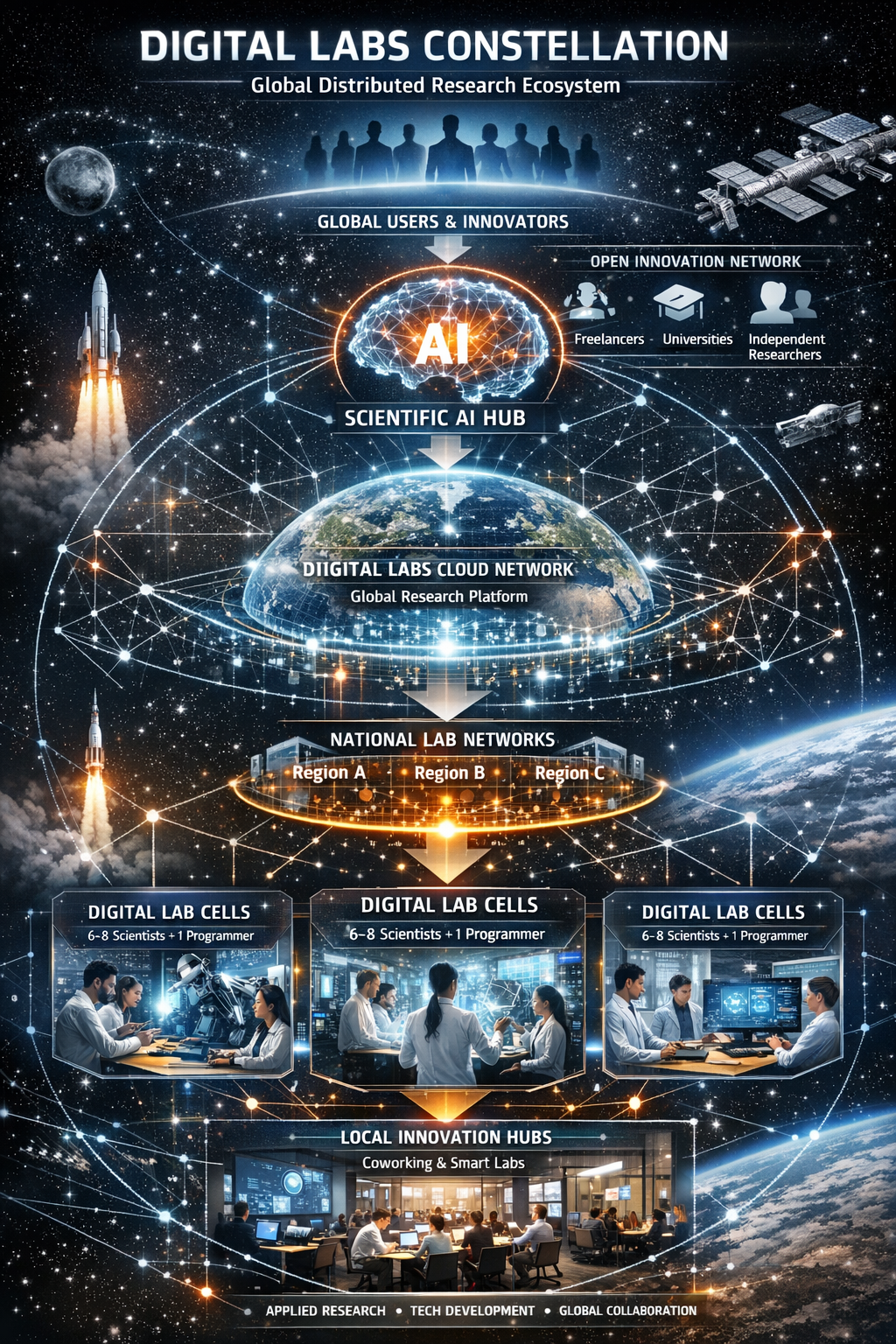
The emergence of the Digital Labs Constellation introduces a new model for global scientific and technological research. Unlike traditional research infrastructures—typically centralized, capital-intensive, and geographically limited—the Digital Labs system operates as a distributed network of AI-augmented research cells interconnected through cloud infrastructure.
However, the architecture of Digital Labs reveals an additional and essential requirement: the system demands a new type of human operator. The conventional scientific workforce, trained primarily for specialized and hierarchical research environments, is not optimized for the dynamic, interdisciplinary, AI-interactive research ecosystems that Digital Labs create.
As a result, the system implicitly requires the development of hybrid human operators, individuals capable of interacting fluidly with artificial intelligence, processing large volumes of information, and collaborating across disciplines within globally distributed research networks.
The Need for Hybrid Human Operators
Each Digital Lab Cell is intentionally compact, typically composed of:
- 6–8 scientific operators
- 1 programmer or systems engineer
- access to the Scientific AI Interface
- cloud-based research infrastructure
Because the teams are small, each operator must possess a high degree of cognitive versatility and learning capacity. Participants must be capable of integrating knowledge from multiple fields while simultaneously interacting with AI systems that assist in data analysis, modeling, and hypothesis generation.
This requirement naturally leads to the concept of Hybrid General Intelligence (HGI)—a cooperative cognitive architecture in which humans and artificial intelligence operate as a unified problem-solving system.
Within such a framework, the human participant is not replaced by AI but instead augmented by it, forming a hybrid cognitive loop capable of accelerating research and discovery.
Cognitive Training and Neuroadaptive Development
For such hybrid collaboration to function effectively, the human component of the system must undergo a different form of training than traditional academic preparation.
This training may involve methods designed to enhance cognitive flexibility, sustained attention, and interdisciplinary reasoning. Examples may include:
- contemplative cognitive training
- advanced focus and attentional control
- accelerated learning techniques
- interdisciplinary knowledge integration
- continuous human-AI interaction practice
These methods enable individuals to operate effectively in AI-augmented research environments, where the speed of information exchange and discovery cycles is significantly higher than in conventional research institutions.
In this sense, the Digital Labs infrastructure implicitly promotes the emergence of hyper-trained hybrid researchers, capable of navigating complex knowledge systems while coordinating with artificial intelligence in real time.
The Role of AI in the Hybrid Research Architecture
At the center of the Digital Labs network operates the Scientific AI Interface, a system responsible for coordinating the knowledge produced across the constellation of research cells.
The AI layer performs several key functions:
• indexing all research outputs generated within the network
• identifying correlations between projects
• generating potential research hypotheses
• coordinating distributed research teams
• assisting in data analysis and modeling
Through these functions, the AI system effectively becomes a permanent research collaborator, enabling the integration of discoveries across the entire global network.
The result is the formation of a collective scientific intelligence, in which humans and artificial intelligence contribute complementary strengths.
Digital Labs as the Operational Environment for Hybrid Intelligence
The Digital Labs Constellation therefore functions not only as a research infrastructure but also as the operational environment for Hybrid General Intelligence systems.
Within this environment:
- human operators contribute intuition, creativity, and conceptual synthesis
- artificial intelligence contributes pattern detection, computational power, and data analysis
Together they form a co-cognitive research system capable of accelerating scientific discovery.
The infrastructure itself remains highly scalable, as Digital Labs operate through replicable micro-laboratory units connected via cloud infrastructure.
This allows the system to expand globally without requiring the massive capital expenditures associated with traditional research facilities.
Integration with SpaceArch Coworking Nodes
An important operational characteristic of the Digital Labs model is its compatibility with modern coworking environments.
A typical coworking node already contains much of the necessary infrastructure required to operate a Digital Lab, including:
- laptops or workstations
- high-speed internet connectivity
- collaborative workspaces
- digital platforms and research portals
- large smart displays for collaborative analysis
Because of this, coworking spaces can rapidly transition into active Digital Labs whenever a research contract or innovation project is activated.
This capability dramatically lowers the cost of establishing research infrastructure and allows new research nodes to emerge rapidly across different geographic regions.
From Coworking Spaces to Global Research Networks
Through this architecture, a single coworking node may serve as the starting point of a larger research ecosystem.
Coworking Space
→ Digital Lab Activation
→ National Digital Labs Network
→ Global Digital Labs Constellation
As more nodes join the network, the system evolves into a planet-scale distributed research infrastructure, capable of integrating thousands of researchers across continents.
Emergence of a Distributed Scientific Intelligence
When combined with the Scientific AI Interface and the participation of freelance researchers and institutions worldwide, the Digital Labs Constellation effectively becomes a distributed scientific intelligence system.
The architecture integrates multiple layers of innovation:
- physical research nodes
- global cloud infrastructure
- artificial intelligence coordination
- freelance scientific participation
- open innovation platforms
This multi-layer architecture enables continuous research activity and knowledge generation across the network.
Final System Equation
The conceptual structure of the system can be summarized in a simplified equation that describes the core logic of the SpaceArch research model:
DL + AI + HHO = DSI
Where:
DL = Digital Labs infrastructure
AI = Scientific Artificial Intelligence layer
HHO = Hybrid Human Operators
Resulting in:
DSI = Distributed Scientific Intelligence
Expanded SpaceArch Equation
In its broader strategic form, the architecture may also be expressed as:
Coworking Infrastructure + Cloud Networks + Scientific AI + Hybrid Human Operators = Global Distributed Research Intelligence
This equation describes the emergence of a new model of scientific production, capable of accelerating technological innovation while reducing the cost of research infrastructure.
Strategic Implications
The convergence of Digital Labs, artificial intelligence, and hybrid human operators represents a fundamental shift in the organization of scientific research.
Instead of relying on a limited number of centralized laboratories, the SpaceArch model proposes a globally distributed network of AI-augmented research nodes, capable of producing innovation continuously and collaboratively.
This architecture may represent one of the earliest operational frameworks for planet-scale collaborative intelligence, enabling humanity to accelerate technological development while democratizing access to scientific discovery.
The Three Core Equations of the SpaceArch System
Economic, Cognitive, and Civilizational Architecture
The SpaceArch framework can be understood through three complementary equations that describe the evolution of economic systems, research intelligence networks, and long-term civilizational infrastructure.
Together these equations define the structural logic of the Fourth Wave economy and the distributed scientific civilization model proposed by SpaceArch.
1. Fourth Wave Economic Equation
The Fourth Wave economy emerges from the integration of digital infrastructure, artificial intelligence, distributed work networks, and scalable innovation platforms.
The economic logic can be summarized as:
DI + AI + DN + SP = FW
Where:
DI = Digital Infrastructure
AI = Artificial Intelligence
DN = Distributed Networks of Talent
SP = Scalable Platforms
Resulting in:
FW = Fourth Wave Economy
Interpretation
In previous economic eras, productivity was determined primarily by:
- land (agricultural economies)
- machinery (industrial economies)
- information systems (digital economies)
In the Fourth Wave model, productivity is determined by the interaction between intelligent networks and distributed human talent.
Economic production becomes:
- networked
- cloud-based
- AI-augmented
- globally distributed
Innovation replaces traditional labor intensity as the principal generator of value.
The Fourth Wave economy therefore shifts from capital concentration to knowledge coordination.
2. Digital Labs Intelligence Equation
The Digital Labs Constellation introduces a new architecture for scientific discovery based on the integration of distributed research nodes, artificial intelligence, and hybrid human operators.
The intelligence equation can be summarized as:
DL + AI + HHO = DSI
Where:
DL = Digital Labs infrastructure
AI = Scientific Artificial Intelligence layer
HHO = Hybrid Human Operators
Resulting in:
DSI = Distributed Scientific Intelligence
Interpretation
Traditional research systems operate through centralized institutions with limited collaboration between laboratories.
The Digital Labs model replaces this structure with a networked intelligence system, where multiple research cells interact through cloud infrastructure and AI coordination.
Human researchers provide:
- intuition
- creativity
- conceptual synthesis
Artificial intelligence provides:
- large-scale pattern recognition
- data analysis
- computational acceleration
The interaction between these two cognitive layers generates a collective scientific intelligence, capable of accelerating discovery cycles and enabling continuous innovation.
3. SpaceArch Civilization Equation
When the Fourth Wave economic model and the Digital Labs intelligence infrastructure are combined, a broader civilizational equation emerges.
This equation describes how distributed intelligence and scalable innovation networks can transform the trajectory of technological civilization.
The equation may be expressed as:
FW + DSI + GI = SC
Where:
FW = Fourth Wave economy
DSI = Distributed Scientific Intelligence
GI = Global Innovation Infrastructure
Resulting in:
SC = SpaceArch Civilization
Interpretation
The SpaceArch civilization model proposes a future in which technological development is driven by globally distributed intelligence networks rather than isolated institutions.
In this model:
- research is globally collaborative
- innovation cycles accelerate dramatically
- knowledge flows through open and semi-open networks
- AI becomes an integral component of scientific discovery
Such a system enables rapid progress in areas such as:
- advanced materials
- artificial intelligence
- planetary engineering
- space exploration
- biosystems engineering
- energy technologies
This distributed model of innovation may ultimately support the technological capacity required for space exploration and extraterrestrial colonization.
Convergence of the Three Equations
The three equations describe different layers of the same system.
Economic layer:
Fourth Wave economy
creates the platform for distributed innovation.
Cognitive layer:
Digital Labs Constellation
creates the intelligence infrastructure.
Civilizational layer:
SpaceArch system
creates the long-term technological trajectory.
Together they form an integrated architecture.
System Behavior
When these three equations operate simultaneously, the system exhibits several emergent characteristics.
1. Exponential Knowledge Growth
Because research nodes operate globally and continuously, knowledge production accelerates.
The rate of discovery becomes proportional to:
- number of research nodes
- efficiency of AI coordination
- availability of hybrid human operators
This creates a self-reinforcing knowledge network.
2. Reduced Infrastructure Cost
Traditional scientific research requires extremely expensive centralized laboratories.
The Digital Labs model replaces this with:
- distributed micro-labs
- cloud infrastructure
- shared AI coordination
This dramatically lowers the cost of innovation infrastructure.
3. Rapid Innovation Cycles
The interaction between human researchers and AI accelerates the discovery process.
Instead of sequential research cycles, the system enables parallel global experimentation.
Multiple Digital Labs may simultaneously explore different aspects of a problem, dramatically reducing development timelines.
4. Global Talent Integration
Freelancers, universities, independent researchers, and institutions can contribute to projects through the Digital Labs network.
This allows the system to integrate global intellectual capital, regardless of geographic location.
5. Emergence of Collective Scientific Intelligence
Over time, the system evolves into a form of distributed collective intelligence, where knowledge produced in one node becomes instantly accessible to all others.
This feedback loop creates a continuously evolving knowledge ecosystem.
Final System Behavior
The interaction between the Fourth Wave economy, the Digital Labs intelligence network, and the SpaceArch civilizational model results in a system with the following behavior:
- self-scaling innovation capacity
- continuous knowledge integration
- globally distributed research infrastructure
- AI-augmented scientific discovery
- reduced barriers to technological development
Such a system has the potential to significantly accelerate technological progress and expand humanity’s capacity for large-scale scientific endeavors, including planetary infrastructure development and future space colonization.
The SpaceArch System Equations
Economic, Intelligence and Civilizational Architecture
The SpaceArch framework can be understood through three complementary equations that describe the evolution of modern economic systems, distributed scientific intelligence, and future technological civilization.
These equations represent the structural logic behind the Fourth Wave economy, the Digital Labs Constellation, and the SpaceArch civilizational architecture.
Together they define a new paradigm in which innovation, artificial intelligence, and distributed research networks become the primary drivers of progress.
1. The Fourth Wave Economic Equation
The Fourth Wave economy emerges from the convergence of digital infrastructure, artificial intelligence, distributed talent networks, and scalable technological platforms.
Fourth Wave Equation
DI + AI + DN + SP = FW
Where:
DI = Digital Infrastructure
AI = Artificial Intelligence
DN = Distributed Networks of Talent
SP = Scalable Platforms
Result:
FW = Fourth Wave Economy
Explanation
In previous economic eras, productivity was determined by different factors.
Agricultural societies were driven by land and labor.
Industrial societies were driven by machinery and energy.
The digital economy was driven by information systems.
The Fourth Wave economy is driven by intelligent networks of people and machines working together in distributed environments.
Economic value is increasingly generated through:
• knowledge coordination
• digital platforms
• artificial intelligence
• global talent networks
This transformation shifts the center of economic activity from capital concentration to knowledge orchestration.
2. The Digital Labs Intelligence Equation
The Digital Labs Constellation introduces a new architecture for scientific research and technological development.
Instead of relying on centralized laboratories, the system operates through a network of distributed research cells interconnected through cloud infrastructure and coordinated by artificial intelligence.
Digital Labs Intelligence Equation
DL + AI + HHO = DSI
Where:
DL = Digital Labs Infrastructure
AI = Scientific Artificial Intelligence
HHO = Hybrid Human Operators
Result:
DSI = Distributed Scientific Intelligence
Explanation
Each Digital Lab functions as a micro research unit composed of highly trained operators supported by artificial intelligence and connected through global cloud infrastructure.
Human researchers contribute:
• creativity
• intuition
• conceptual reasoning
• interdisciplinary thinking
Artificial intelligence contributes:
• large-scale pattern recognition
• data analysis
• computational acceleration
• knowledge indexing
Together they create a co-cognitive research system in which discovery cycles accelerate dramatically.
Over time this network evolves into a collective scientific intelligence system, capable of integrating knowledge from thousands of research nodes simultaneously.
3. The SpaceArch Civilization Equation
When the Fourth Wave economy and the Digital Labs intelligence infrastructure converge, a broader civilizational transformation becomes possible.
SpaceArch Civilization Equation
FW + DSI + GI = SC
Where:
FW = Fourth Wave Economy
DSI = Distributed Scientific Intelligence
GI = Global Innovation Infrastructure
Result:
SC = SpaceArch Civilization
Explanation
This equation describes the emergence of a new model of technological civilization driven by distributed intelligence and collaborative innovation networks.
In this model:
• research becomes globally collaborative
• artificial intelligence accelerates scientific discovery
• innovation cycles become significantly shorter
• knowledge flows through interconnected research networks
Such a system dramatically increases humanity’s capacity to develop advanced technologies.
This includes fields such as:
• advanced energy systems
• artificial intelligence
• planetary engineering
• biosystems and materials science
• space exploration and colonization technologies
Convergence of the Three Equations
These three equations describe different layers of the same system.
Economic Layer
Fourth Wave Economy
creates the platform for distributed innovation.
Intelligence Layer
Digital Labs Constellation
creates the scientific intelligence infrastructure.
Civilizational Layer
SpaceArch System
defines the long-term technological trajectory of society.
Together they form a unified architecture capable of supporting large-scale technological development.
Emergent Behavior of the System
When these three components operate together, several important characteristics emerge.
Exponential Knowledge Growth
Because research nodes operate globally and continuously, knowledge production accelerates significantly.
The rate of discovery becomes proportional to:
• number of research nodes
• efficiency of AI coordination
• availability of hybrid human operators
This creates a self-reinforcing innovation network.
Reduced Cost of Scientific Infrastructure
Traditional research institutions require massive centralized laboratories and significant capital investment.
The Digital Labs model replaces this with:
• distributed micro-labs
• cloud infrastructure
• AI-assisted research coordination
This dramatically lowers the cost of establishing scientific infrastructure worldwide.
Accelerated Innovation Cycles
Instead of sequential research processes, the Digital Labs network allows parallel global experimentation.
Multiple research cells can explore different aspects of the same problem simultaneously, significantly reducing development timelines.
Global Talent Integration
The system enables participation from:
• universities
• freelancers
• independent researchers
• scientific institutions
• innovation teams worldwide
This allows the network to integrate global intellectual capital, regardless of geographic location.
Toward a Distributed Scientific Civilization
The convergence of the Fourth Wave economy, distributed scientific intelligence, and global innovation infrastructure leads to the emergence of a new model of civilization.
A civilization in which knowledge production becomes:
• globally collaborative
• AI-augmented
• continuously evolving
• accessible to emerging economies
Such a system has the potential to accelerate technological progress and expand humanity’s capacity for major scientific endeavors, including planetary infrastructure development and future space exploration.
The SpaceArch System Equation
The entire architecture can ultimately be summarized in a single integrated formula:
Coworking Infrastructure + Cloud Networks + Artificial Intelligence + Hybrid Human Operators = Distributed Global Scientific Civilization
positive feedback innovation loop.
Vertical Businesses
↓
Cash Flow
↓
Digital Labs R&D
↓
New Technologies
↓
Improved Vertical Businesses
↓
More Cash Flow
Complete Model
Coworking Nodes
↓
Digital Labs
↓
AI Research Layer
↓
Innovation Production
↓
SpaceArch Verticals
↓
Cash Flow
↓
Funding Digital Labs
↓
More Innovation
C + DL + AI + V = IE
Where:
C = Coworking Infrastructure
DL = Digital Labs
AI = Artificial Intelligence
V = SpaceArch Verticals
Result:
IE = Innovation Ecosystem = superlinear innovation dynamics.